
Sometimes the most meaningful investment isn’t a grant.
It’s an opportunity for a nonprofit leader to step away from the urgency of the day-to-day and think strategically about the future of their organization. It’s a board that begins functioning differently. A fundraising strategy that gains momentum. A financial process that becomes clearer. A volunteer who arrives ready to ask thoughtful questions, share professional expertise, and leave with lasting relationships and a deeper connection to the mission.
Those moments have quietly unfolded across dozens of nonprofit organizations over the past six years through Social Venture Partners Charlotte’s Spark Teams.
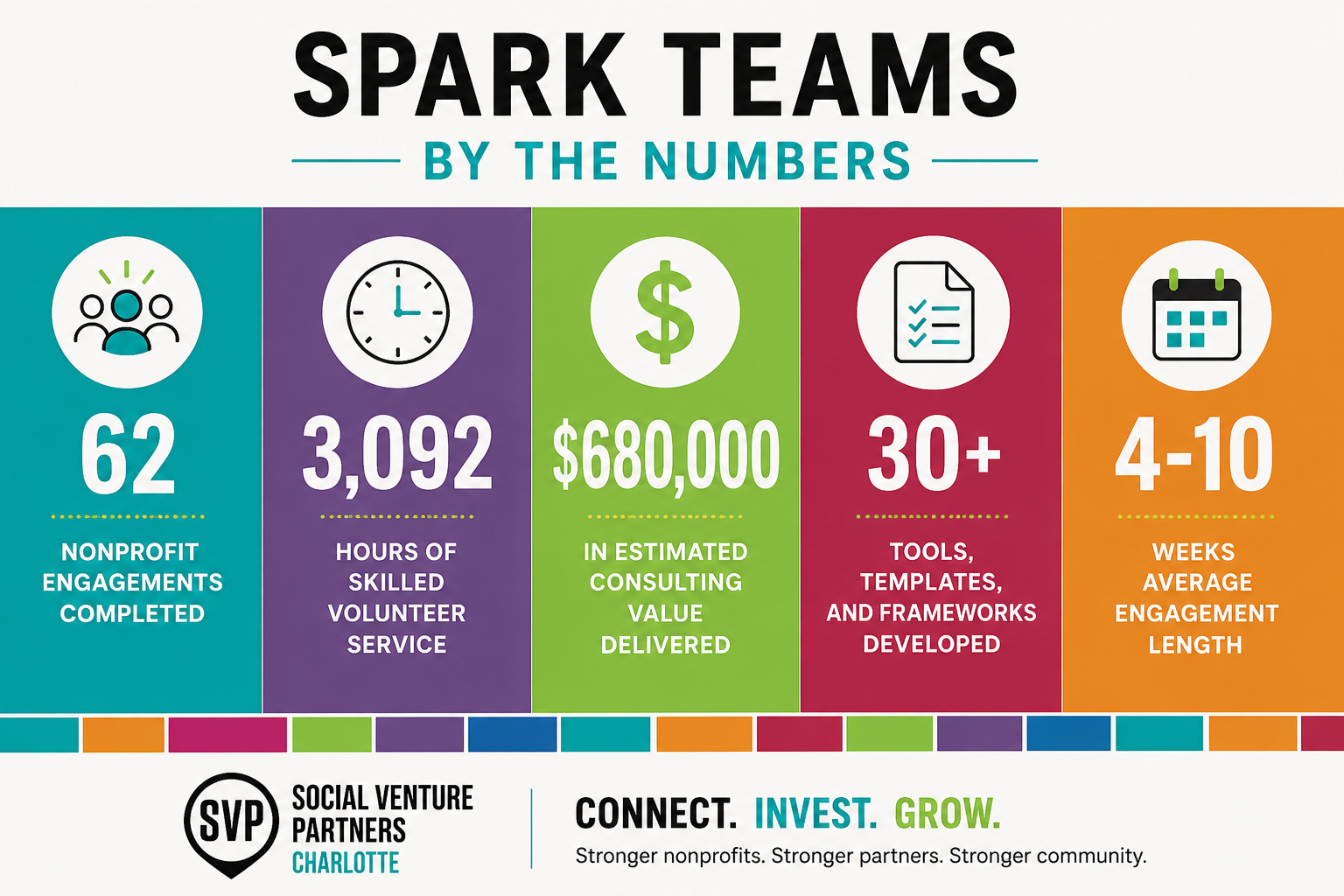
What began in 2020 as a new way to connect the knowledge and experience of SVP Partners with the evolving needs of nonprofit organizations has grown into one of the organization’s defining programs. Since its launch, Spark Teams have completed 62 nonprofit engagements, contributed more than 3,092 hours of skilled volunteer service, and delivered an estimated $680,000 in consulting value throughout our region.
Those numbers tell an important story.
But they don’t tell the whole story.
To understand the impact of Spark Teams, you have to look beyond the final deliverable.
Built for a Moment. Designed to Last.
The first Spark Teams weren’t created because SVP Charlotte wanted another volunteer program. They were created because nonprofit organizations were navigating extraordinary uncertainty, and our Partners wanted another way to show up.
As the pandemic disrupted fundraising, paused programming, and changed how organizations operated almost overnight, one thing remained unchanged: the expertise, leadership, and networks within the SVP community.
The question became how to put that expertise to work.
Rather than simply providing additional funding, Spark Teams were designed to harness the professional experience of SVP Partners to help nonprofit organizations navigate complex challenges. Before launching the program, SVP reached out to our SEED20 alumni organizations to better understand what kind of support would be most valuable. The response confirmed what many nonprofit leaders already knew: while funding was essential, organizations also needed trusted thought partners who could strengthen governance, operations, fundraising, strategy, and long-term sustainability.
The first pilot launched with six projects.
What began as a response to a moment in time has since become one of the most meaningful ways SVP Partners invest their talents alongside nonprofit organizations.
Every Spark Team looks different because every nonprofit begins with different opportunities and challenges.
Some organizations need stronger governance. Others need fundraising strategies, financial guidance, operational improvements, marketing support, or strategic planning. Spark Teams are intentionally designed to meet organizations where they are, pairing nonprofit leaders with Partners whose experience aligns with their greatest needs.
While every engagement produces tangible deliverables, the goal has always extended beyond the final presentation or recommendation.
It’s about helping organizations build the internal capacity, confidence, and infrastructure to continue growing long after the engagement concludes.
What Does Impact Actually Look Like?
For much of the program’s history, success was relatively easy to define.
Did the project finish?
Were the recommendations delivered?
Was the nonprofit satisfied?
Today, six years later, we’re asking different questions.
What changed?
What endured?
What are we learning from it?
This year, SVP Charlotte introduced a new two-part feedback process, inviting nonprofit leaders to share their experiences immediately following a Spark Team engagement and again six months later. Rather than measuring only the experience itself, we’re beginning to better understand what continues long after the project ends.
The early findings have been remarkably consistent.
Every responding organization said they would recommend Spark Teams to another nonprofit. Organizations continue using governance frameworks, operational systems, fundraising strategies, and planning tools months after their engagements conclude. Perhaps most telling, several organizations shared that their ongoing relationship with SVP has become just as valuable as the original project deliverables.
It reminds us that Spark Teams don’t simply strengthen nonprofit organizations. They strengthen how SVP listens, learns, and serves. Every engagement gives us a better understanding of where organizations continue to need support and how we can become more effective partners in the future.
Impact in Practice
Every Spark Team engagement tells a different story.
Digi-Bridge – Building Capacity Through Partnership
As Digi-Bridge continued to grow, leadership recognized the need for stronger internal systems that could support the organization’s future. Working alongside staff, the Spark Team helped map business processes, identify opportunities for greater efficiency, and build operational practices that could continue evolving long after the engagement concluded.
Hear directly from CEO Alyssa Sharpe about the experience and the impact the Spark Team had on Digi-Bridge’s continued growth.
Arin’s Good Girl Dog Treats – Building a Stronger Board for the Future
For Arin’s Good Girl Dog Treats (AGGDT), the opportunity looked very different. As the organization experienced significant growth, leadership recognized that its board was functioning more as an advisory group than the active working board needed to support the organization’s future.
Over the course of five meetings and approximately forty volunteer hours, the Spark Team worked alongside the organization to develop board role descriptions, committee charters, governance recommendations, recruitment strategies, bylaw revisions, and an onboarding framework for future board members. Together, those deliverables created a roadmap toward stronger governance and greater organizational sustainability.
Following the engagement, Executive Director Talia Wucherer shared,
“Your insights and assistance have been crucial in helping us make AGGDT a stronger and more impactful organization. Your commitment to our growth has been truly inspiring, and we’re excited to implement these changes to carry AGGDT forward.”
Organizations like Digi-Bridge and Arin’s Good Girl Dog Treats represent very different projects, but together they illustrate a consistent theme.
Spark Teams strengthen organizations by helping leaders build the systems, confidence, and capacity needed to move forward long after the engagement ends.
While projects may be measured in weeks, the relationships they create often continue much longer.
“Spark Teams create space for real partnership to take root. What starts as listening and collaboration often turns into something much deeper. You see trust build, perspectives shift, and momentum carry forward well beyond the project itself.
I’ve experienced that firsthand. After Spark Team engagements, I’ve been invited to join the boards of two organizations I supported. It’s hard not to stay involved when you’ve built those relationships and seen the impact up close.”
— Henry Lander, Spark Team Lead
Henry’s experience reflects something we’ve heard repeatedly from nonprofit leaders as well.
The work often begins with a project, and then continues through relationships built on trust, shared purpose, and a genuine investment in one another’s success.
Every Spark Team Teaches Us Something
Perhaps the greatest lesson from the past six years is that every Spark Team becomes a shared learning experience. Nonprofit organizations strengthen their capacity, while every engagement gives SVP Charlotte new insight into how we can better support the organizations we serve.
Every engagement offers insight into the challenges nonprofit leaders are facing, the expertise Partners are eager to share, and the kinds of support that create lasting value. Rather than allowing those lessons to live only within individual projects, we’re becoming more intentional about capturing and sharing them across the program.
This year, we’re strengthening the Spark Teams Steering Committee to help ensure the program continues evolving alongside the changing needs of nonprofit organizations and the interests of our Partners. We’re refining project intake, strengthening expectation-setting at the beginning of engagements, and using nonprofit feedback to continuously improve the Spark Team experience.
These process improvements are evidence of a broader commitment to listening well, learning continuously, and ensuring every Spark Team benefits from the lessons of the last.
Looking Ahead
Six years ago, Spark Teams began with a simple belief: that the knowledge, experience, and generosity of our Partners could strengthen nonprofit organizations in ways that funding alone never could.
Today, after 62 engagements, thousands of volunteer hours, and countless relationships, that belief continues to prove true.
Every Spark Team leaves behind stronger systems. Stronger leadership. Stronger relationships. Stronger organizations.
Every engagement also leaves us with something else: a deeper understanding of how to become even better partners to the nonprofit leaders we serve.
As we celebrate six years of this work, we’re grateful for every Partner who has shared their expertise, every nonprofit leader who has invited us alongside them, and every lesson that continues to strengthen this program.
Are you a SEED20 Alumni organization interested in working with a Spark Team? To learn more or submit a request, visit our Spark Team Request Form.